
Cosmology - Particle Physics & The Big Bang (Continues)
OPENING QUESTIONS: There is a *critical* part of our timeline that kind of makes no sense:
"First Light", "Dark Era" or some such. Here's an interesting riddle for you. How is it that "First Light" occurs so long after the Big Bang, and yet we learned yesterday that gamma ray light was created in abundance in the first millisecond (or so)?
Please discuss- this is a tough one!
OBJECTIVE:
I will be able to sketch basic atomic structure showing fundamental particles (Today)
I will be able describe the Universe within the first 3 minutes of "Planck Time" after today's class (Probably Tomorrow)
WORDS FOR TODAY:
- Planck Time
- Proton (a non-fundamental particle, contains u-u-d quarks, has +1 charge)
- Electron (a fundamental particle of nature, has -1 charge)
- Neutron (a non-fundamental particle, contains d-d-u quarks)
- Up Quark (a fundamental particle of nature, has + 2/3 charge)
- Down Quark ((a fundamental particle of nature, has -1/3 charge)
- Strong Force (between quarks)
- Weak Force (not exactly a force)
- Electromagnetic force (between protons & neutrons)
- Gravity (between objects with mass)
WORK O' THE DAY:
Please turn to the person next to you and describe how the internal structure of a neutron differs from the internal structure of a proton.
Let's discuss.
Now please list the four forces of nature in order from weakest to strongest.
1) Gravity -- The force whereby any object with mass interacts with any other object of mass. The defining features of that force are the mass of the two objects involved, and the distance separating those two objects. Gravity is moderated by the 'graviton' particle
2) The Strong Force: The Strong Force is the force that holds quarks together inside protons and neutrons. The strong force only acts on VERY small distances. However the strong force has an unusual property in that the farther apart the quarks, the stronger the force between them. The Strong Force is moderated by the 'gluon' particle.
3) The Weak Force: The Weak Force is the force responsible for certain types of radioactive decay in the nucleus of an atom. The Weak Force is much, much weaker than the Strong Force (as you'd suspect) and is moderated by the W and Zo(pronounced "Z naught") particles.
4) The Electromagnetic Force: The Electromagnetic force is the positive/negative attraction between protons and electrons inside an atom. The particle that moderates that force is our good friend, the photon.
Please continue working on your Big Bang Timelines
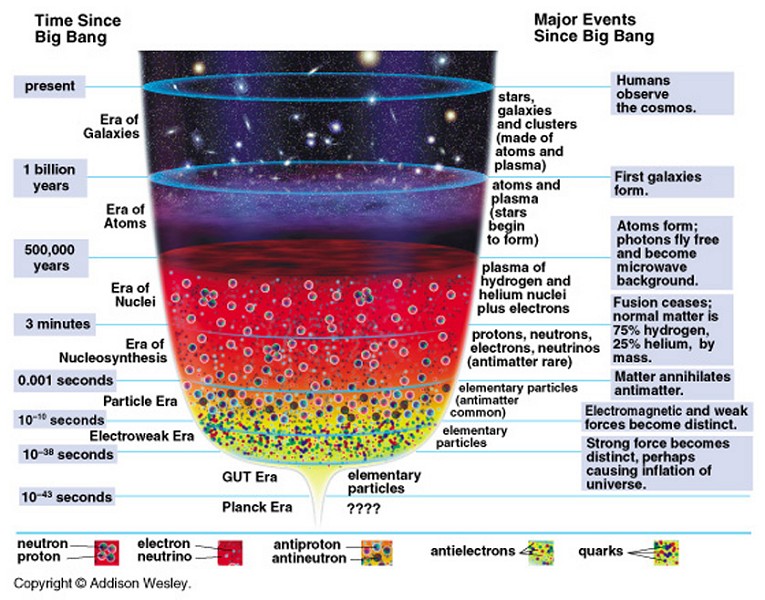
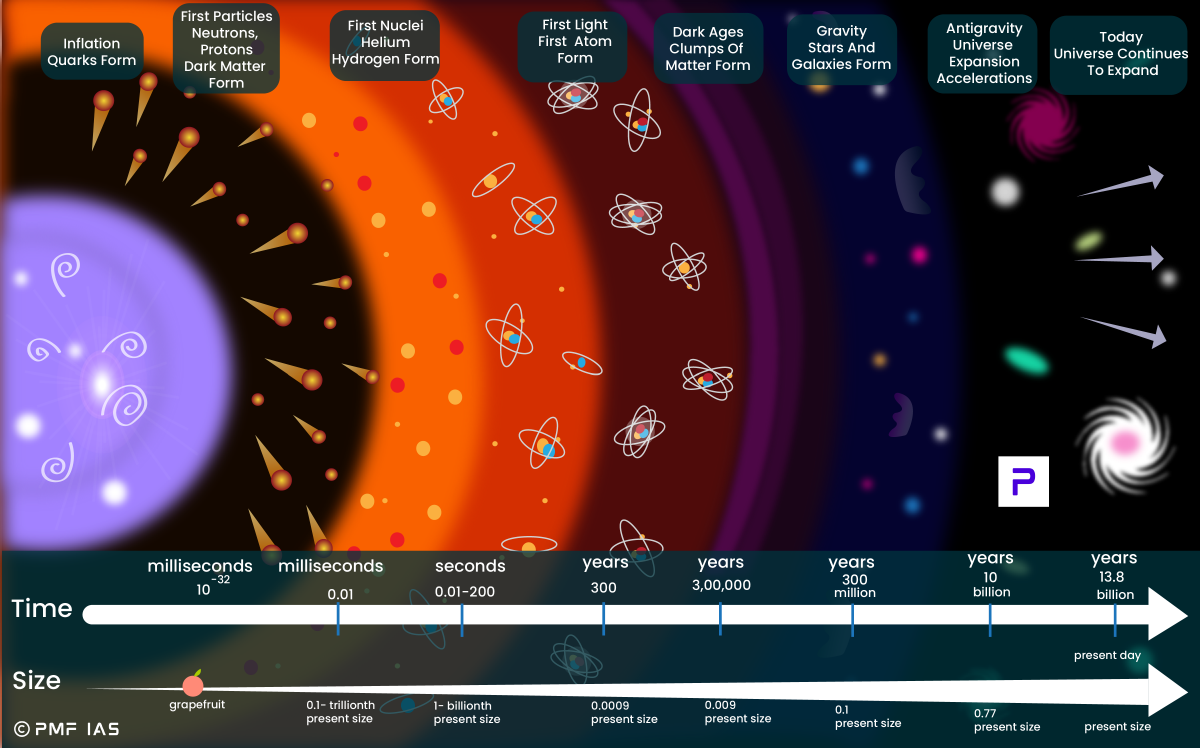
Time |
T ( °C) |
Event |
10-43 Sec |
1032 |
Planck Time: The cosmos goes through a super fast “inflation,” expanding from the size of an atom to that of a grapefruit in a tiny fraction of a second. |
10-32 Sec |
1027 |
Post-inflation: the universe is a seething, hot soup of electrons, quarks, and other particles. |
10-6 Sec |
1013 |
Basic Matter Forms: A cooling cosmos permits quarks to clump into protons & neutrons. |
10-3 Sec |
1013 |
Matter/Anti-matter annihilation: Most anti-matter destroyed, gamma light created |
3 min |
108 |
Dark Era: Still too hot to form into atoms (protons w/electrons) so visible light isn't created |
300,000 years |
103 |
Light Finally shins: Electrons combine with protons & neutrons to form atoms, mostly hydrogen & helium. Lithium & beryllium were formed in trace amounts. |
~1 billion years |
-200 |
Stars & Galaxies Form: Gravity makes hydrogen and helium (primordial elements) coalesce to form the giant clouds that will become galaxies; smaller clumps of gas collapse to form the first stars. |
13.7 billion years |
-270 |
Current Era: As galaxies cluster together under the influence of gravity, the first stars die and spew heavy elements into space: those will eventually turn into new stars and planets. |
Planck Time is particularly interesting:
Planck Time is 10-43 seconds after the Big Bang... that would be one ten millionth of a trillionth of a trillionth of a trillionth of a second after the Big Bang.
Planck Time is the LAST time all of the 4 forces of nature were all clumped together as one force.
As the Universe expanded past Planck Time, the gravitational force peeled away to become a unique and separate force. We currently don't have data to understand how that happened, but scientists are working to develop a Grand Unified Field Theorem (sometimes called the Theory of Everything) that is something of the Holy Grail of particle physics.
However, we do have very good theory and math to help us understand the Universe up to about 10-37 seconds after the Big Bang.
The interesting aspects of this are that we don't think we'll *ever* be able to get any closer than 10-43 seconds after the Big Bang. We just don't have the beginnings of any sort of theory or math to serve as a basis for doing that.